
0%

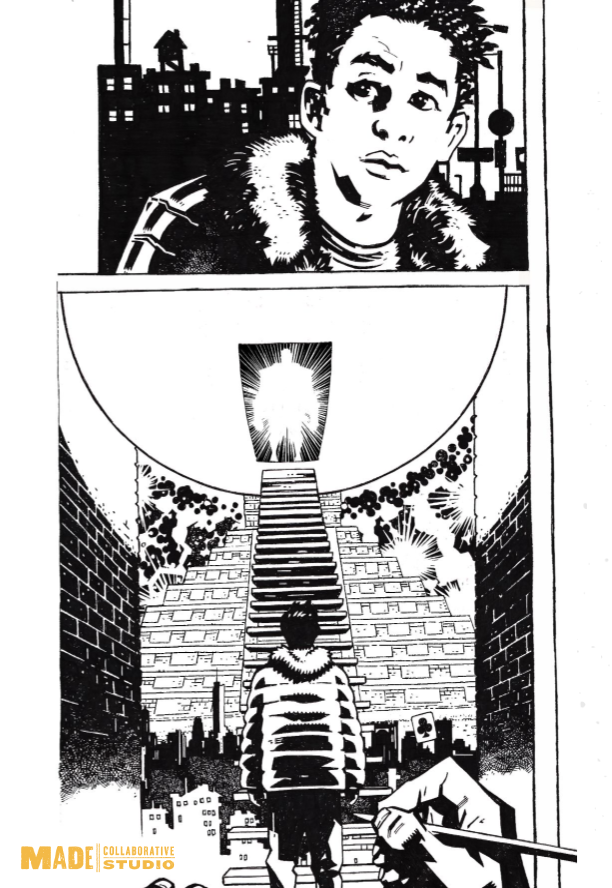
| Summary | For Issue #3, we're returning to our Create a Character framework - but this time, we're opening the halls of New City High and inviting you to help us populate them. From students and teachers to administrators, friends, rivals and unexpected personalities, we'll use the same creative process introduced earlier in the Studio to build the community surrounding Andre and Tamia. At least two of the characters created through this collaboration will appear in Issue #3 - with the possibility that others may return in stories still to come. |
|---|---|
| Background | Early in Issue #3, Dex Coleman encounters a young man he doesn't recognize. We know this character will matter to the developing story. What we haven't fully decided is exactly who he is. |
| This & That | Selected ideas and artwork may be featured through Made Collaborative and considered as we develop the character who ultimately appears in Issue #3. Contributors whose ideas are incorporated into the finished comic will be credited as part of its development. |
Back of the Yards began with character creation.
Years ago, during Made Collaborative’s original classroom workshops on the West Side of Chicago, young collaborators began imagining characters of their own. Those early collaborations helped give us characters including Andre Davis, Tamia Parker and Russell Patterson—and ultimately helped launch the world of Back of the Yards.
So as we begin opening Issue #3 to collaboration, we’re returning to where the project started. We’re creating someone new.
Early in the developing story for Issue #3, Dex Coleman encounters a young man he doesn’t recognize. We know where this character enters the story. We have some ideas about where his story may eventually lead. But exactly who he is remains open.
The exercises below will walk you through some of the same building blocks we use when developing characters – physical traits, background, personality, values and biography. You don’t have to complete every step. Follow whatever sparks your imagination.
By the end, you’ll have your answer to one of Issue #3’s first open questions: Who does Dex see?

Let’s start with the basics.
When Dex first sees this young man in the alley, he doesn’t know his name, where he comes from or why he’s there. He only knows what he can see.
And that’s where we’ll start too.
What does this young man look like? How old does he appear to be? How does he dress? How does he carry himself? Does he look like he belongs in the neighborhood — or like someone Dex has never seen before?
As you work through this first step, we’ll use Andre Davis, one of the first characters created through the original Made Collaborative workshops. as a frame of reference for how a few basic physical and background details can begin to make a character feel real.
We have also included a copy of Issue 1 of the Back of the Yards comic series here for your convenience, which you can access here by clicking below. This issue was based on the original collaborations with participating youth in the West Side of Chicago, with new characters and scripting further developed by Len Kody and Jimmy Briseno, illustrations by Dan Dougherty.
You will also see an option to download and print a PDF copy of the workbook on the bottom toolbar of the flipbook (the first icon on the right side of that bottom toolbar).

Here are some character physical traits that can enhance storytelling. For example, hair color and style can help distinguish your character. Eye shape and eye color is another example (as the old saying goes, eyes can be a window to the soul). Facial features like high cheekbones, firm jawlines, nose shape or size, skin town, etc. And, of course, body type can capture your character’s build and indicate physical strengths or weaknesses. These are just a few physical traits for you to consider as you develop your character. And for your convenience, we’ve included a few more in the table below as well a helpful link here for other physical traits you may consider when developing your character at this stage!
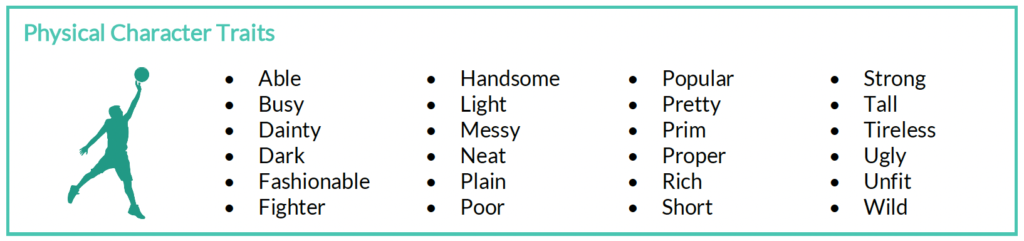
And to further help with your character’s basic background description, here’s a quick list of elements to consider age, birthdate, gender, birthplace, race/nationality, marital status, education, current residence and occupation and languages among other basic background elements to consider before we start taking a deeper character dive below.
It may help you to think of this first step (combining personality traits and basic background elements) as if you were making an introduction to your character in a movie screenplay. Within screenplays, a basic character description is the literal introduction of a character, which then translates into the visual introduction in a movie. As such, a good concise description of some of the very basic characteristics within the screenplay is essential.
As an example, look at the following character introduction from the script of the movie Training Day, starring Denzel Washington.
“DETECTIVE SERGEANT ALONZO HARRIS, IN BLACK SHIRT, BLACK LEATHER JACKET. AND JUST ENOUGH PLATINUM AND DIAMONDS TO LOOK LIKE SOMEBODY. HE READS THE PAPER IN A BOOTH. THE GUN-LEATHER-TOUGH L.A.P.D. VET IS A HANDS-ON, BLUE-COLLAR COP WHO CAN KICK YOUR ASS WITH A LOOK."
Within this character introduction, you can get a feel for the physical appearance of Alonzo Harris, as well as some basic insights into his background and current occupation (gun-leather-tough LAPD vet, blue-collar cop).
Now, see how that short basic description translates to the big screen by clicking below!

Before you begin imagining the young man Dex sees, there’s someone else you should know about. More than thirty years earlier, Dex knew another young neighborhood figure named Darius King –better known around Back of the Yards as “The Broker.”
King disappeared in 1994, leaving behind questions that were never completely resolved. We don’t yet know what – if any – connection exists between King and the young man Dex encounters in Issue #3.
But something about this new character may echo the past.
We’re not asking you to recreate Darius King. This is a new character with his own personality, history and future.
But as you begin creating him, keep King somewhere in the back of your mind.
Explore the file below if you’d like to know more.

What Does Dex Notice First? Picture the moment Dex first sees this young man.
What catches his attention? Think about the character’s age, build, hair, clothing, facial features, posture or anything else that might stand out.
What are the first physical details Dex notices?
Now look beyond his appearance.
How old is he? Does he live in Back of the Yards? Did he grow up here—or is he new to the neighborhood? Does he go to school? Work? Have family nearby?
You don’t need to know his entire story yet. Just start with a few basic details that give us a sense of the life he may have lived before Dex encountered him.
Now bring those ideas together.
Using the Training Day example above as inspiration, imagine that you’re writing the young man’s first appearance in the Issue #3 screenplay.
In just two or three sentences, introduce us to the person Dex sees.
What would the reader see before they knew anything else about him?
In Step One, we began with what Dex can see – the young man’s appearance, some basic details about his background, and the first impression he might make.
Now let’s look beneath the surface.
What is this young man actually like?
Is he confident or insecure? Quiet or outspoken? Careful or impulsive? Does he trust people easily, or keep everyone at a distance?
A character’s personality shapes how they respond to the world around them—and often tells us far more about them than their appearance ever could.
So for Step Two, we’ll begin thinking about the traits that make this young man distinctly him – that is, we will begin thinking about his personality. And perhaps no other character in cinema today has as complicated of a personality than the comic villain that goes by the name of The Joker …

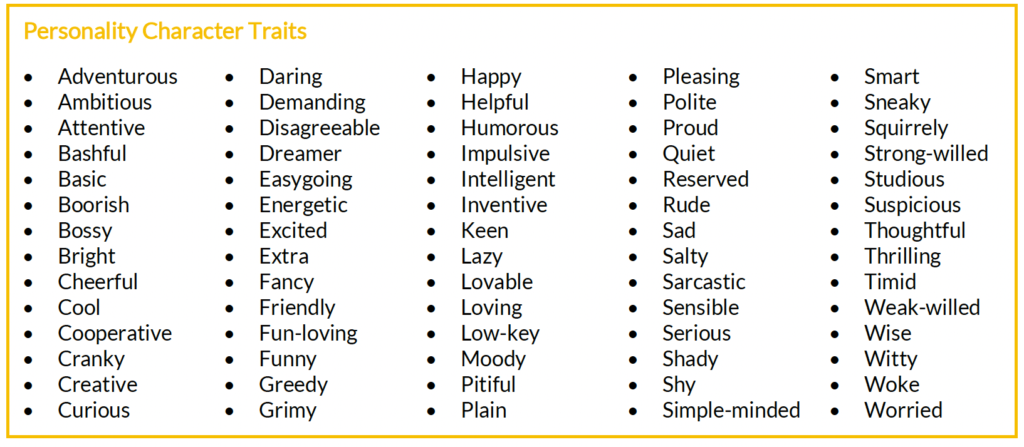
How would you describe the Joker’s personality? What words come to mind? Impulsive? Disagreeable? Humorous? Creative? Daring? Unpredictable? Would any of the traits listed below apply to the Joker’s personality?
You can find an even more extensive set of personality traits by clicking here to visit a site presented by ProWritingAid, an independent company devoted to providing writers with creative resources and assistance to help develop writing skills.
In stark contrast to The Joker's fictional comic personality, we have chosen to feature the real-life legacy of one of the most iconic artists of our time, Frida Kahlo.
Frida Kahlo was a Mexican painter known for her deeply personal and symbolic self-portraits that explored identity, pain, and the female experience. Her work blended elements of Mexican folk art with surrealist influences, often reflecting her physical suffering and tumultuous relationship with fellow artist Diego Rivera. Despite lifelong health challenges, she became an icon of resilience, feminism, and Mexican cultural pride.

If you watched the short video above, how would you describe Frida’s personality from the traits listed above? Creative? Daring? Inventive? Thoughtful?
These are just some personality traits that may come to mind when describing Frida, and as you can see, apart from perhaps a shared creativity and daringness in their approach to life, Frida is otherwise quite the contrast in personality to Joker’s fictional character.
And this contrast in personality traits between the fictional character of the Joker and the real-life legacy of Frida Kahlo could also be captured by something even more fundamental to each of their characters – something referred to as their respective “Character Archetypes,” which will turn our attention to in Step Three below. But first! …
Think about the young man you’ve begun creating.
Choose three to five personality traits that describe him.
Is he confident? Guarded? Loyal? Reckless? Funny? Suspicious? Ambitious? Impulsive? Something else entirely?
Don’t worry about whether the traits are “good” or “bad.” Interesting characters usually contain a little of both.
Dex only has a brief encounter with this young man. Like any of us, he’s going to make assumptions based on what he sees.
What might Dex initially get wrong about him?
Maybe someone who appears threatening is surprisingly thoughtful. Someone who seems confident is actually terrified. Someone who looks reckless has a very specific reason for taking risks.
What’s beneath the first impression?
Personality often reveals itself most clearly when something goes wrong.
Imagine this young man is challenged, embarrassed, threatened or forced to make a quick decision.
What does he do?
Does he confront the problem? Walk away? Make a joke? Lose his temper? Protect someone else? Pretend he isn’t afraid?
What does his reaction tell us about who he really is?
By now, our character is beginning to take shape. We have some sense of what Dex sees when he first encounters him—and what kind of personality might exist beneath that first impression.
Now let’s go a little deeper: What drives him?
Characters become more interesting when we understand what they value, what they want and what they fear losing. One way writers think about those deeper motivations is through character archetypes – familiar patterns that help us understand the role a character may play in a story. An archetype doesn’t define everything about a character. Think of it instead as another tool for understanding what may be pulling them forward.
Returning briefly to the Joker and Frida Kahlo personalities from Step Two above, in addition to highlighting these two very different personalities, we also can see a contrast of two very different life paths. The fictional character of Joker dedicated to mayhem and chaos in response to his early life adversity. Frida Kahlo, on the other hand, who experienced very serious near-fatal medical injuries as a youth, somehow heroically channelling that adversity towards creative expression, art and a unique celebration of life.
To help better understand these two divergent life paths, we present you with an overview of Character Archetypes.
Our quick overview of character archetypes begins with an individual named Carl Gustav Jung, a Swiss psychiatrist who is recognized as one of the most influential figures in modern psychology.
Among his many intellectual pursuits, Jung explored the hidden and mysterious aspects of the mind and as part of that exploration, he theorized that some dreams may actually hold intriguing insights into life and the world because they come from the “collective unconscious.”
Jung believed the collective unconscious is bigger and more fundamental than the mind of any single individual; it is the profound and timeless wisdom that all humans share. And it is from this collective unconscious that certain distinct and common character archetypes also emerge.
Just click below to learn more about these Character Archetypes, including which Archetypes might describe The Joker, Frida Kahlo and other well known characters and other historical figures!

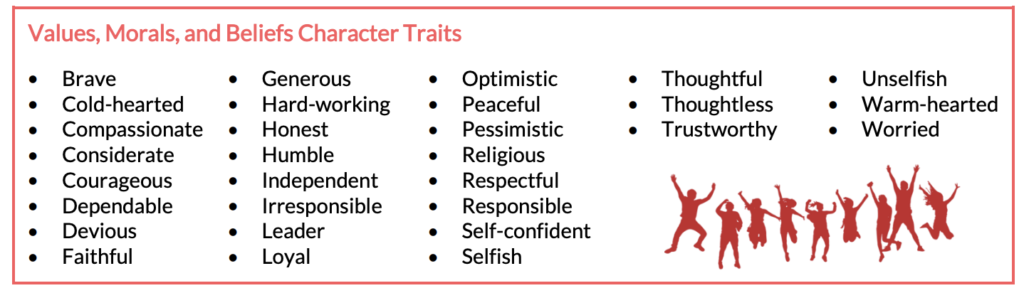
As you consider Character Archetypes, a closely related set of traits are your character’s “core values.” Core values are fundamental beliefs and principles that guide a person’s actions and decisions. In short, core values can be described as a character’s personal compass as they navigate through life.
We have provided a sample list of such core value traits below. It is your Character’s Archetype combined with their core values that will ultimately drive your character’s actions in any given story.
And if helpful, you can access a more comprehensive list of core values by linking here.
****
Think about the archetypes above. Which one – or combination – feels closest to the young man you’re creating?
More importantly, what does he want?
Respect? Belonging? Independence? Security? Recognition? Revenge? A way out? Something else entirely?
What matters enough to him that it might influence the choices he may make in Issue #3 and beyond?
Earlier, we introduced you to Darius King.
Dex knew King more than thirty years ago. And while the young man Dex encounters in Issue #3 is someone entirely new, we’re interested in the possibility that something about him causes the past to echo forward.
Look at the character you’ve created so far. What, if anything, might remind Dex of Darius King?
It could be something obvious – or something Dex can’t quite put his finger on yet.
A personality trait?
An ambition?
The way he carries himself?
His role in the neighborhood.Something about his circumstances. Or perhaps the resemblance lies somewhere else entirely.
This young man is not Darius King. Give him something that could only belong to him.
What makes his worldview, motivation, personality or history fundamentally different from King’s?
What is something about this character that Dex could never have anticipated based on what he remembers about the past?
So now that you have all the basic building blocks of your character in place, including their basic characteristics, core personality traits and archetype core values, we are ready for a lightening round of sorts! It is here that we will begin to sprinkle in some of the details of your character’s back story and other interesting facts that make your new character unique! And to help you do this, we will present to you 100 quick and easy questions for you to consider within the Google Slide presentation below.
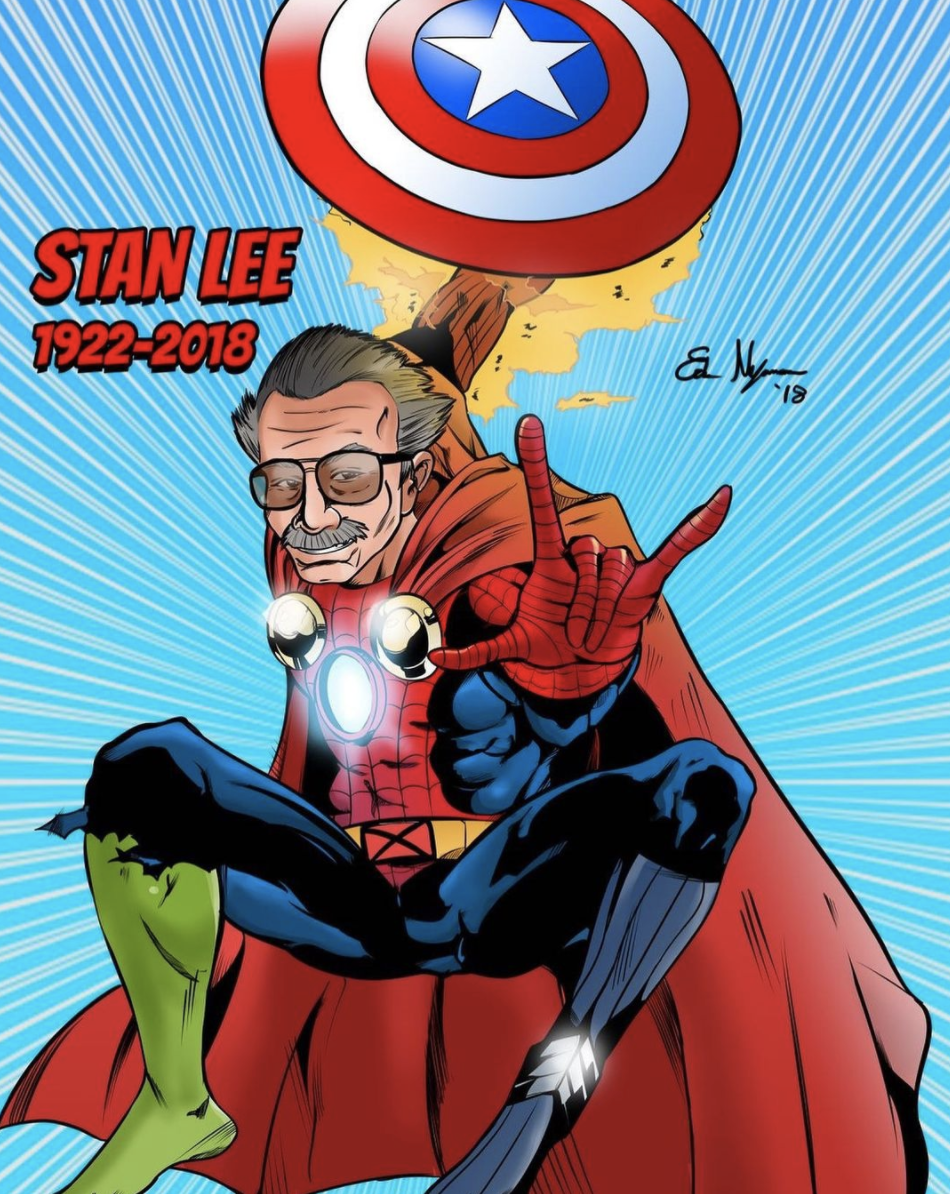
And for a little creative inspiration, we bring you a few words from Stan Lee, creator of Spiderman, the Fantastic Four, the Hulk, Black Panther and many more from the Marvel universe.
(Original art to the right by participating artist, Eric Nyamor.)
By now, this young man is becoming more than the person Dex happens to notice.
We have some idea of what he looks like, how he carries himself, what kind of personality lies beneath the surface and what might be driving him.
Now let’s give him a life.
Every character existed before the moment we first meet them. They have families, friendships, memories, disappointments, ambitions and experiences that shaped who they became.
We may never see all of those details on the page. But knowing them can help turn a character from an idea into someone who feels real.
So for our final step, let’s think about who this young man was before Dex ever saw him.
Every character has a life before we meet them.
Think about the young man Dex sees. Where did he grow up? Who raised him? Who matters to him? What experiences have shaped the person he is becoming?
Give us a little of his story before Dex ever sees him.
Now bring his past into the present.
Why is this young man here, in this neighborhood, at this particular moment?
Is he looking for someone? Running from something? Trying to prove himself? Protecting someone? Looking for somewhere he belongs?
What does he want—and how might that have brought him into Dex’s path?
We’ve imagined what he looks like. We’ve explored his personality, what drives him, where he comes from and what might connect him to the past.
There’s just one thing left.
What’s his name?
It can be his real name, a nickname, or both. Dex doesn’t know who this person is yet. But you do.
You've seen what we know.
Dex encounters someone he doesn't recognize.
You've also been introduced to Darius King - a man Dex knew more than thirty years ago, before King disappeared in 1994.
We know these stories are connected. But we haven't decided exactly how.
That's where you come in.
We're developing the person Dex sees at the beginning of Issue #3 - and we'd like you to help us figure out who he might become.
ENTER THE WORKSHOP →
No drawing skills required. Just bring your imagination.


Although by no means, required, but to the extent you have developed any concept sketches or illustrations of your new character, we encourage you to submit those illustrations to us. Just do us a favor and let us know which character you are submitting illustrations for, and we will absolutely make sure our artists receive them when they are reviewing your character submissions!
And we may feature your artwork in the future either on the project website or directly in our comic issues, all subject to your approval!

Who is…
Andre Davis?


Who is…
Russell Patterson?

Who is…
Carl Castaneda?

Introducing a New Hero’s Journey
Back of the Yards!

Neighborhoods
& Their Residents!

Law Enforcement &
The Community

Some special pieces may be selected to appear in the Back of the Yards comic book. iPad/iPhone users, submit images from FILES (NOT from Photo Library).
Some special pieces may be selected to appear in the Back of the Yards comic book.
UPLOAD YOUR IMAGES BELOW
Some special pieces may be selected to appear in the Back of the Yards comic book.
UPLOAD YOUR IMAGES BELOW
Some special pieces may be selected to appear in the Back of the Yards comic book.
UPLOAD YOUR IMAGES BELOW
Some special pieces may be selected to appear in the Back of the Yards comic book.
UPLOAD YOUR IMAGES BELOW
Collaborate with professional artists by contributing some artwork of your own! Some special pieces may be selected to appear in the Back of the Yards comic book.
UPLOAD YOUR IMAGES BELOW