A collaborative comic book project inspired by Chicago youth — and an invitation to help shape what happens next.
Welcome to Made Collaborative!
If you’re discovering us for the first time — and unless you’ve been among the small group working on this project over the years, you probably are — we’re glad you’re here. Whether you’re a comic book fan, an aspiring artist, a professional artist, an educator, a student, or simply someone who enjoys a good story, there’s a place for you here.
Made Collaborative began with a simple idea: What if young people could work alongside aspiring and established artists to explore and develop their own creativity and imagination?
That idea would quickly evolve into in-person after-school workshops in Chicago’s west-side neighborhoods, where students worked alongside writers and artists to imagine characters, develop storylines, and explore the possibilities of collaborative storytelling.
Those early workshops eventually inspired Back of the Yards, an original comic series that brings together neighborhood history, fictional characters, and the creative contributions of young people.
Today, we’re expanding that original concept through an online Virtual Studio platform we’ve cobbled together through years of grit and grind outside of our day jobs — with the hope of making it easier for anyone, anywhere, to explore the project and participate.
First, Explore the Comic
If you’re new to our modest collaborative project, perhaps the best place to begin your orientation is with the comic stories themselves. The first two issues of Back of the Yards introduce readers to a fictionalized Chicago neighborhood where ordinary lives intersect with extraordinary forces.
You’ll meet young characters finding their way through school, friendships, family relationships, and the challenges of growing up. You’ll also begin to encounter a larger mystery involving the neighborhood’s past—and powerful forces operating beneath the surface.
Issues #1 and #2 are available to read online, giving you an opportunity to discover the characters and the world we’ve already begun building.
Next, Enter the Studio
Our next chapter is Back of the Yards Issue #3. And rather than developing every element of the story behind closed doors — true to the comic’s early creative origins — we’re inviting readers, students, artists, educators, and other collaborators to participate in the creative process.
We’ve organized the experience around 12 featured Issue #3 collaborations, along with four bonus Studio collaborations exploring additional characters and story possibilities. Each collaboration offers a different opportunity to explore the Back of the Yards universe.
You might help imagine a new neighborhood location, develop a character attending New City High, uncover something from a character’s past, or explore a mystery that could influence future stories.
And you don’t have to be an experienced artist or writer to participate.
How Does It Work?
Each featured collaboration connects three simple elements:
- Explore the Collaboration. Start with a short introduction to a character, setting, or story opportunity.
- Discover the Studio Card. Dive deeper into the background, artwork, story history, and creative possibilities surrounding that collaboration.
- Enter the Workshop. Follow a few creative prompts and share your ideas through a simple online form.
Some Workshops invite written responses. Others welcome artwork, character concepts, or imaginative interpretations. You can participate in one Workshop or explore several. It’s really all about your own creative and collaborative interests.
And the goal of this collaborative process isn’t to find one right answer. It’s to see what new possibilities emerge when different people bring their imaginations to the same story.
Your Ideas Can Become Part of the Collaborative Story
One of the most exciting aspects of Made Collaborative is the opportunity for creative contributions to influence the comic itself. As we develop Issue #3, selected ideas, characters, settings, and other contributions may help shape the story, artwork, or future Studio collaborations.
Not every submission will appear in a published comic, and participation doesn’t guarantee selection. But every Workshop is designed to give participants a meaningful opportunity to explore the creative process. Some contributions may inspire new directions. Others might spark conversations, artwork, or additional collaborations.
And sometimes, one small idea can become the starting point for something much bigger.
That’s precisely how Back of the Yards began in a classroom years ago, and it’s the fusion of creative ideas and thought that we’re seeking to foster going forward.

A Shared Creative Commons
In this way, Back of the Yards is intended to be more than a comic series. It’s a shared creative universe that we want others to explore, expand, and make their own.
That’s why we’ve made designated characters, storylines, settings, and other creative materials available under a Creative Commons Attribution–ShareAlike 4.0 International License (CC BY-SA 4.0).
What does that mean for you?
You can use our licensed characters and storylines to create your own comics, artwork, stories, and other original projects. You can even sell what you create.
We simply ask that you give appropriate credit and, when sharing adaptations of our licensed material, make those adaptations available under the same or a compatible Creative Commons license—so others can build upon your creativity, too.
And if you contribute to one of our Workshops? You retain ownership of your original creative contributions. Our Terms & Conditions explain how submitted work may be incorporated into Back of the Yards and shared under the Creative Commons framework. Certain materials, including our logos, trademarks, finished comic artwork, and other specifically excluded assets, remain protected.
Our goal is simple: a creative universe where everyone has an opportunity to contribute, creators retain ownership of their original work, and new ideas can inspire even more ideas.
You can learn more in our Terms & Conditions.

Collaboration Is Easy — and Free
This project began with a simple premise: creative thinking is an undervalued skill, and opportunities to develop it should be accessible to everyone — especially young people in urban communities where funding for arts and enrichment programs is often under pressure.
Of course, that simple idea eventually evolved into a comic book project. And we fully recognize that many of you have never written a comic book story. Heck, yours truly hadn’t either when this journey began.
More importantly, you might not even consider yourself an artist or a particularly creative person. Maybe you have an idea but aren’t sure where to begin. That’s exactly why we’ve designed our Workshops to be approachable. You don’t need special software, professional experience, or a finished piece of artwork.
All you need is a little curiosity and a willingness to imagine something new.
Our Studio Cards provide the background. Our Workshop prompts help get you started. And you can participate at your own pace.
For educators and after-school programs, these resources can also serve as free creative exercises for young people — introducing storytelling, character development, world-building, and visual imagination through an existing comic book universe.
For artists and writers, the Studio offers opportunities to explore existing characters, experiment with new ideas, and potentially connect with future collaborative projects.
And for anyone simply interested in comics, it’s another way to become part of the storytelling experience.
Discover the Story Behind Made Collaborative
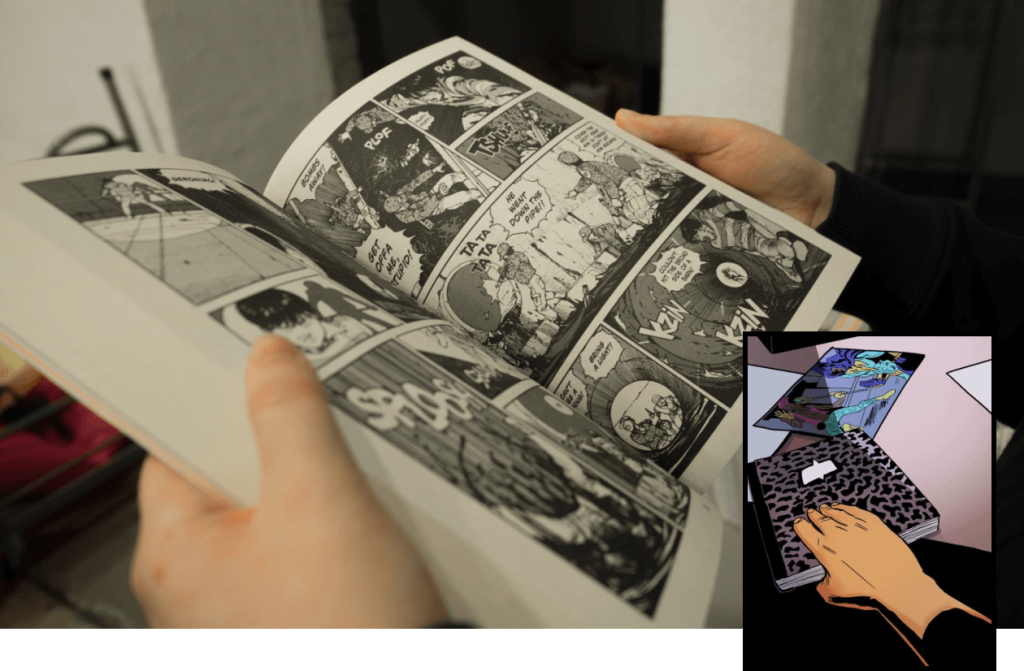
The comic and Virtual Studio are only the latest chapters in a much longer creative journey. Through our This & That blog, you can explore how Made Collaborative began in Chicago classrooms, how students and artists worked together to develop the original comic, and how those early experiences continue to influence what we’re building today.
Our earlier posts share the stories, challenges, inspirations, and creative experiments that helped bring Back of the Yards to life. And that history leads directly to the next chapter.
And in our next This & That blog entry, Inside the Issue #3 Dossier: The Stories We’re Building Together, we’ll take you deeper into the characters, mysteries, and creative opportunities shaping our next comic issue — including how contributions from our Workshops may help influence the story as it develops.
Your Invitation
Whether you want to read the comic, explore a character, contribute an idea, create original artwork, or introduce these resources to young people in your community, we hope you’ll find something here that sparks your imagination.
You can start small. Explore one Studio Card. Try one Workshop. Share an idea. And see where it leads.
Because the next great idea for Back of the Yards might come from someone who hasn’t discovered the project yet.
Maybe that someone is you.
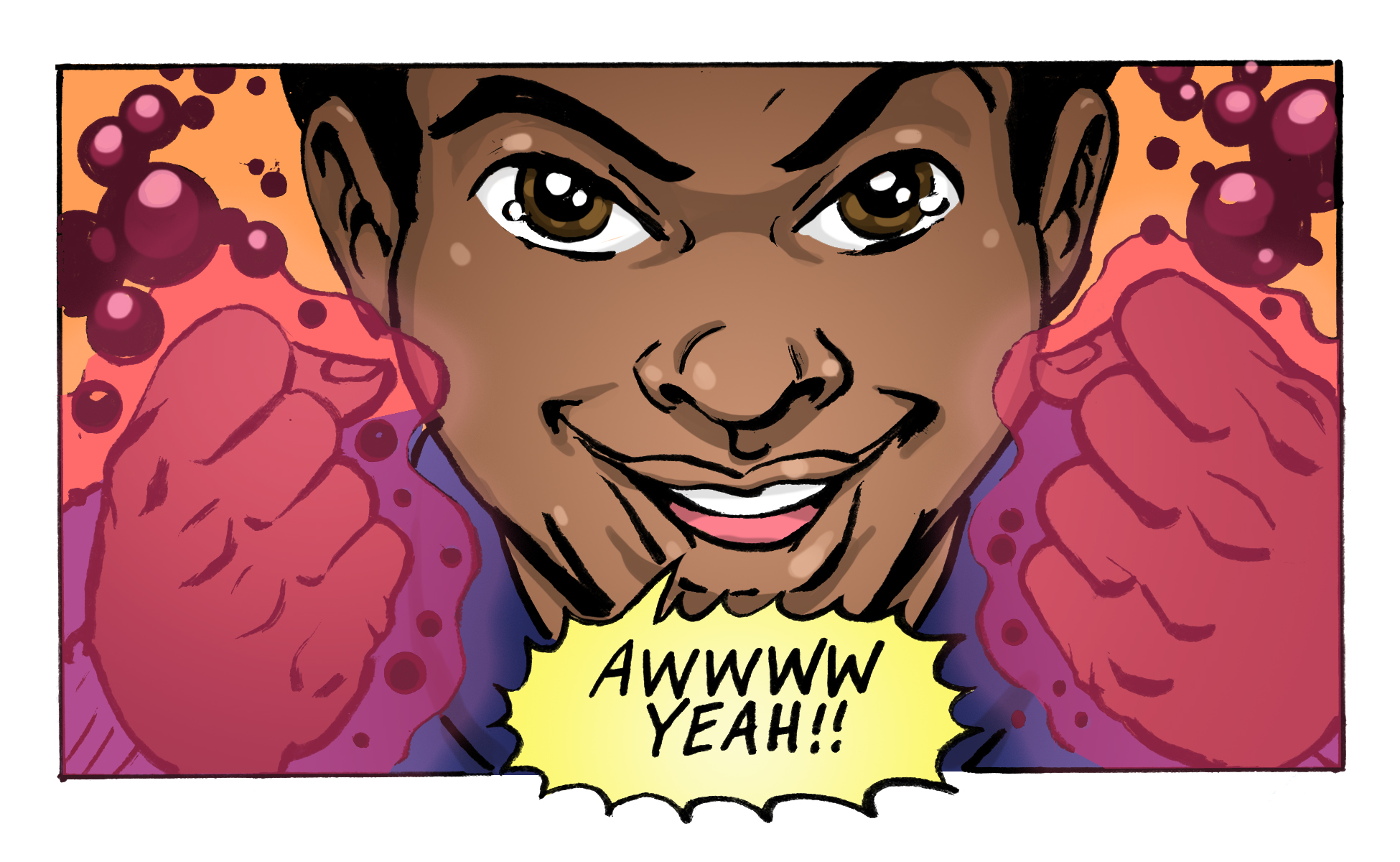
Hello & Welcome!
When we first began what would eventually become Made Collaborative, I never imagined that one day I would be drafting a blog like this.
Back then, the idea was remarkably simple.
Gather together a few artists at an afterschool program. Invite a group of young people into the same room. Ask them what kinds of stories they wanted to tell. Then do our very best to help bring those stories to life.
That was it.
There was no grand publishing plan. No long-term roadmap. Certainly no expectation that one day we would be developing an interconnected comic universe centered around the neighborhoods of Chicago. We simply believed that creativity mattered – and that young people’s ideas deserved to be taken seriously.
Over time, however, something unexpected began to happen.
As artists, educators, and participating youth continued contributing ideas, individual stories slowly began connecting with one another. Characters evolved. New characters emerged. Neighborhoods developed their own personalities. Themes began repeating themselves in unexpected ways. Small ideas became larger ideas. Before long, we realized we were no longer simply creating individual comic stories – we were gradually building a shared world.
During that journey, I was fortunate to be joined by my friend and creative partner, Len Kody. Together, we have spent countless hours expanding the world of Back of the Yards — developing its characters, mythology, history, and long-term vision. I have often said that Made Collaborative is built upon the belief that meaningful stories grow through collaboration, and few people embody that belief more than Len. His imagination, thoughtful storytelling, and unwavering belief in what this project and this comic series could become have helped shape The Back of the Yards in ways that simply would not have been possible on my own.
The Back of the Yards is one result of that collaborative journey.

While the comic series is fictional, its foundation is very real. It is inspired by conversations, sketches, classroom discussions, neighborhood observations, and creative contributions made over many years by artists, educators, community members, and young people who chose to imagine something together.
Through our This & That blog series, we hope to share more about the evolving mythology, history, and world of Back of the Yards, along with the creative journey behind Made Collaborative itself.
Our first several blog entries serve as a starting point for that journey. They provide a frame of reference for the project — how a simple idea, a group of young people, and a handful of artists gradually evolved into the comic book universe we’re continuing to build today. To tell that part of the story, we’ve repurposed several entries from our own internal project journal and are sharing them with you here.
Going forward, This & That will explore more of the neighborhood we’re building, the characters who inhabit it, the institutions and systems that shape it, and the creative philosophy that continues to guide the comic’s development. We’ll also share project announcements, updates from our Virtual Studio, and highlights of creative contributions from young people, artists, and other collaborators helping shape the project along the way.
Some of the characters you’ll encounter in these stories have already appeared in the published comics. Others will make their first appearance in future issues. Still others remain little more than names, sketches, or unfinished conversations waiting for the right moment to emerge.
Like the project itself, they’re still evolving.
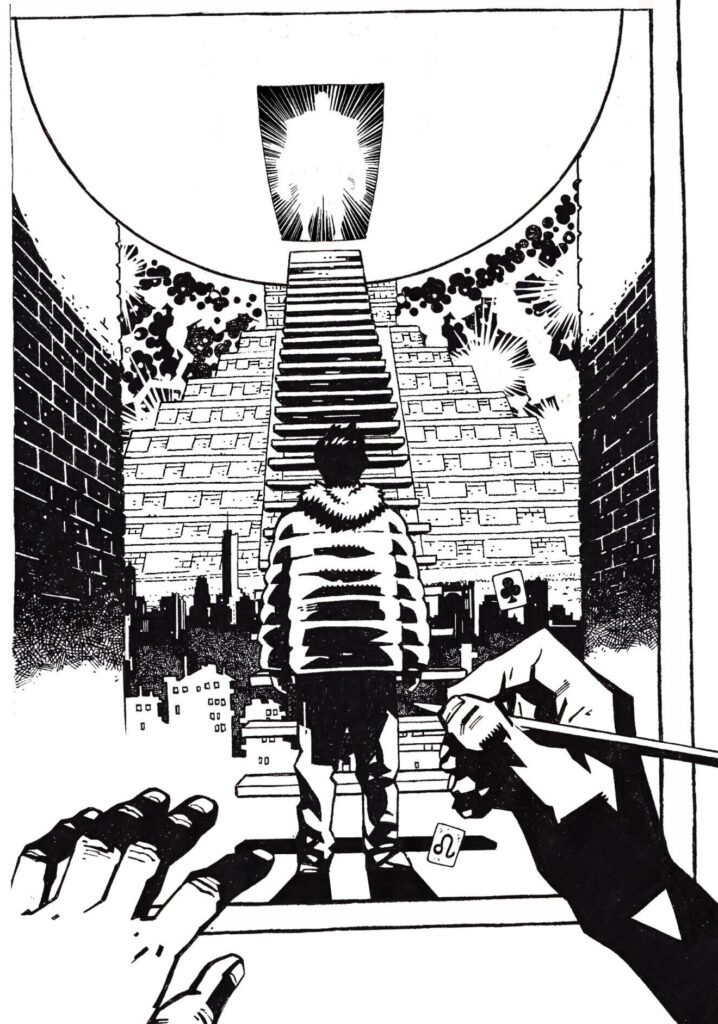
That is part of what makes this work so rewarding.
One lesson I have learned through Made Collaborative is that meaningful stories are rarely built by a single individual. They grow through conversation. They improve through collaboration. They become richer when people with different experiences, talents, and perspectives choose to build something together.
Every artist brings a unique visual voice. Every writer asks different questions. Every educator helps uncover new ways of thinking. Every young person reminds us that imagination is limitless when it is encouraged.
Together, those contributions, from creative partners and artists to educators, community members, and participating youth, become something none of us could have created alone.
If you’ve found your way to this opening blog series, we hope you’ll become part of that process, too. Whether you are an artist, writer, educator, student, or simply someone curious about the world of The Back of the Yards, I hope these pages serve as both a practical guide and an open invitation. There is still much of this neighborhood left to discover, many questions left unanswered, and many stories still waiting to be told.
Thank you for choosing to become part of this journey.
And welcome to the Made Collaborative Studio!
– Jimmy Briseno
Over our first three origin stories, we’ve shared how Made Collaborative began with an idea, how that idea found its way into a Chicago classroom, and how the imaginations of our earliest youth collaborators quickly transformed it into something much bigger.
But one important question remained.
How do you turn an extraordinary collection of unrelated ideas into an actual comic book?
For our fourth and final entry in this introductory series, we’re turning things over to Made Collaborative Studio Director and co-creator Len Kody, who helped us begin answering that question.
Here’s his perspective on how the early collaborative process gave rise to the fictional world of Back of the Yards.
When the Story Behind the Stories Became a Story of Its Own
By Len Kody
The magic of creativity begins with inspiration, but it can only be sustained through unwavering dedication and tireless grinding.
Project founder Jimmy Briseno has since recruited others to grind with him on the Made Collaborative journey (and we’re certainly glad he did), but the journey began with him standing alone in front of a classroom full of kids waiting to see what he was going to say next.
It took a little coaxing at first to get things started, but once the kids caught the storytelling bug, they were off and running. Bringing a small team of artists into the collaborative process was the natural next step. Their role wasn’t to replace the kids’ ideas, but to help expand them – adding greater depth and legitimacy to everything Jimmy had documented during those early after-school creative sessions.
Together, Jimmy, the artists, and the youth refined and expanded upon a remarkable collection of narrative ideas. Every one of them originated with the participating youth, inspired by their own lives and heightened by the stories, comics, films, and games they loved. Over time, the team assembled what was, in effect, a series bible: model sheets, storyboards, character descriptions, plot outlines, world-building notes, and even preliminary scripts.
It contained all the ingredients of a great comic – romance, adventure, humor, and that all-too-elusive authenticity that came directly from the participating youth. But it still wasn’t a comic book. Only the ingredients of one.
Telling a Story About Telling a Story
The first round of collaborations produced an extraordinary variety of narrative content, which was exactly what the participating youth had been encouraged to do: tell whatever story they believed was worth telling. But that creative freedom also presented a challenge. How do you bring all of these seemingly unrelated ideas together into a single, cohesive narrative?
An anthology of disconnected stories would certainly have been easier, but not nearly as engaging. We, on the comics production team, were inspired by the youth’s authentic, original stories and driven to produce something worthy of the courage it takes to nurture creativity and make something new within Chicago’s often-harsh urban environment.
We wanted to reach a little higher.
But how?
Eureka!
Then it hit us.
What if the comic itself mirrored the way it had actually been created?
In other words, what if the teenage characters from all of these different stories attended the same school? What if they all participated in the same after-school arts program? What if they already knew one another? And what if that program was led by the same mysterious mentor – a new character named Carl Castaneda?

Suddenly, these independent stories no longer felt independent at all. They became different windows into the same world.
Presenting the comic in this way created two important opportunities for the production team.
First, it allowed us to incorporate elements of Made Collaborative’s own origin story into the fictional universe itself. Because, as fascinating as the students’ stories were, equally compelling was the story behind those stories – the story of the young people who created them.
Second, it challenged us to search for the deeper themes connecting those seemingly unrelated narratives. At first, those connections weren’t obvious. Some stories were grounded in everyday reality, while others ventured into mythology, fantasy, romance, or science fiction. Yet the search ultimately bore fruit, leading us on a journey that began in Chicago’s Back of the Yards neighborhood and expanded into places beyond space and time.
So how does a story of young love and betrayal connect to secret chiefs from another dimension? How do the video game fantasies of two young cousins become part of something much larger? And how is the magic of creativity and storytelling somehow responsible?
Those were – and still are – the questions that continue to shape the universe we invite you to explore, imagine, and help build with us in the issues ahead.
So, I had a dream.
And this is the honest-to-God truth.
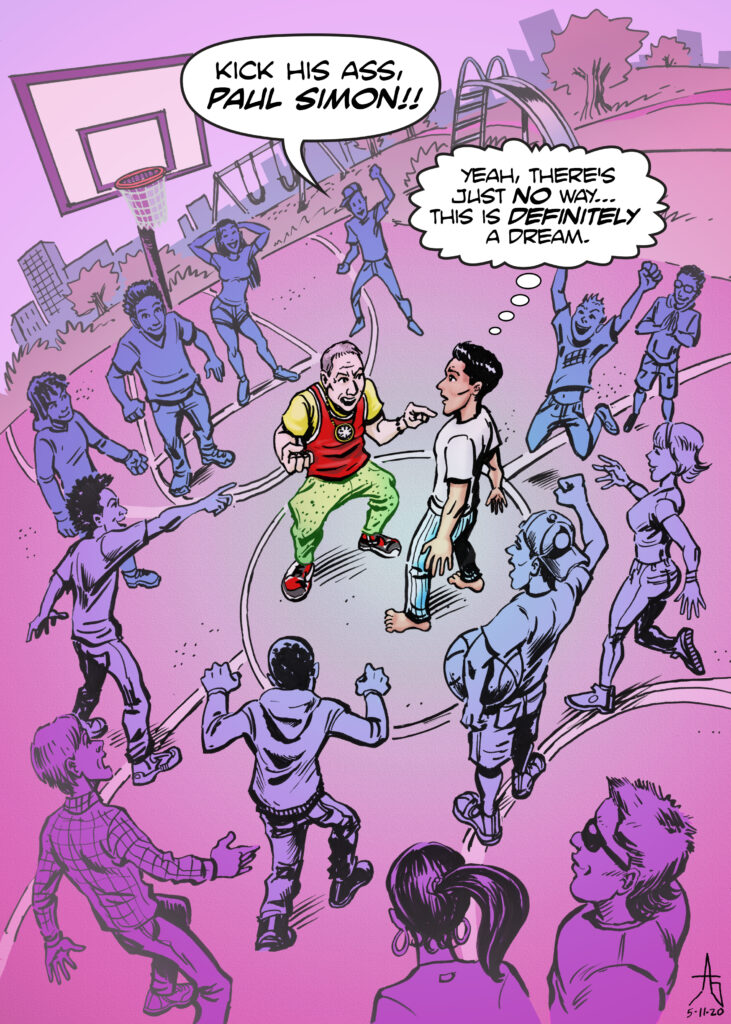
The other night, I dreamed that Paul Simon – you know, Paul Simon from Simon & Garfunkel? – was trying to fight me.
Paul who, some of you may ask?
Fair question.
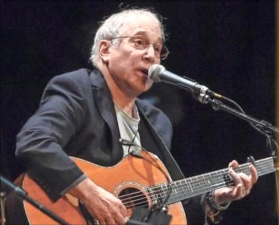
Paul Simon is one of America’s most celebrated singer-songwriters. His career has spanned more than six decades and includes classics such as Bridge Over Troubled Water, Mrs. Robinson, Still Crazy After All These Years, and Fifty Ways to Leave Your Lover.
And not some young version of Paul Simon.
No.
The current nearly 80-year-old, 5’3″, 140-pound version of Paul Simon.
Yeah.
And I mean an actual fight.
There he was, taunting me as a crowd of onlookers gathered around us like some bizarre elementary school playground scene, all presumably waiting to watch Paul Simon kick my ass.
For what reason, only the dream gods know.
I remember waking up shortly after Paul Simon poked me in the chest and asked if I was “feeling froggy.”
I immediately nudged my then-fiancée – now wife – to tell her about the dream before I forgot it.
Just so damn random.
Thoroughly unimpressed, she rolled over, muttered something unintelligible (possibly in Polish), and went right back to sleep.
But I couldn’t shake it.
Paul Simon wanting to go fisticuffs?
What the hell was that about?
How do you even begin to psychoanalyze something like that?
Dreams…they’re funny things.
Of course, countless books and articles have been written about dreams. Some believe they’re windows into our subconscious – the fears, hopes, and unresolved conflicts that quietly shape us beneath the surface.
Others argue they’re simply our minds processing the events and problems of everyday life.
And still others insist they’re nothing more than random electrical impulses firing while our brains drift through REM sleep.
Who the hell really knows?
Perhaps it’s precisely because dreams remain such a mystery that they became such a recurring theme during our earliest collaborations with the participating youth.
Time and again, almost every young person we worked with referenced dreams as part of their stories or characters. No other theme appeared as often.
It was in that context that I began wondering whether dreams themselves could become the thread that connected these seemingly unrelated stories into one larger narrative. Maybe dreams could become the bridge.
Maybe they could become the doorway into a shared mythology that future youth could continue building upon. The idea intrigued me.
The execution…
That was another matter entirely.
By that point, I had conducted countless interviews with participating youth, worked alongside professional artists to produce concept sketches and illustrations, and even drafted early scripts. Yet something was still missing.
Creatively, I had hit a wall.
And as I thought about it more, perhaps that’s what Paul Simon represented in my dream.
Not Paul Simon, the musician. But Paul Simon, the creative giant. A towering artistic presence (figuratively speaking, of course) standing across from me, quietly exposing every insecurity I had about my own creative abilities.
And maybe the crowd surrounding us represented the participating youth whose ideas I was desperately trying to honor as I struggled to bring this project to life.
Or…
Maybe it really was nothing more than random brain impulses before a much-needed REM cycle. Either explanation seemed equally plausible. Regardless, one thing had become abundantly clear while I was dreaming about getting my ass kicked by Paul Simon.
I needed help.
Okay…
Let me be more specific.
I needed help with the project.
And on that score…
Enter Len Kody.
In our first origin story, Sparks From a Bus, we shared how a series of ordinary bus rides through Chicago eventually inspired the idea behind Made Collaborative.
But having an idea is one thing. Actually putting it into practice is something else entirely.
Our next entry takes us back to one of the earliest classroom sessions, when a handful of young people on Chicago’s West Side were invited to help create comic stories of their own.
Among them was a young man named Andre, whose imagination would help lay the foundation for much of the fictional world we’re still developing today.
Here’s how that first creative spark began to take shape.
The Classroom: Day Zero
By Jimmy Briseno
The room looks like any other ordinary high school classroom. A long counter stretches across the front for the teacher, while rows of single desks line the room from front to back. I stand at the front of the classroom.
Sitting with me are a small group of students who had already been given a brief description of the project. I can feel their scrutiny as I bring my presentation to a close.
“So, that’s the idea in a nutshell. Basically, we’re going to develop comic stories based on your ideas. And you’ll be able to participate in the development of those stories from beginning to end, so long as you’d like to participate in the project.”
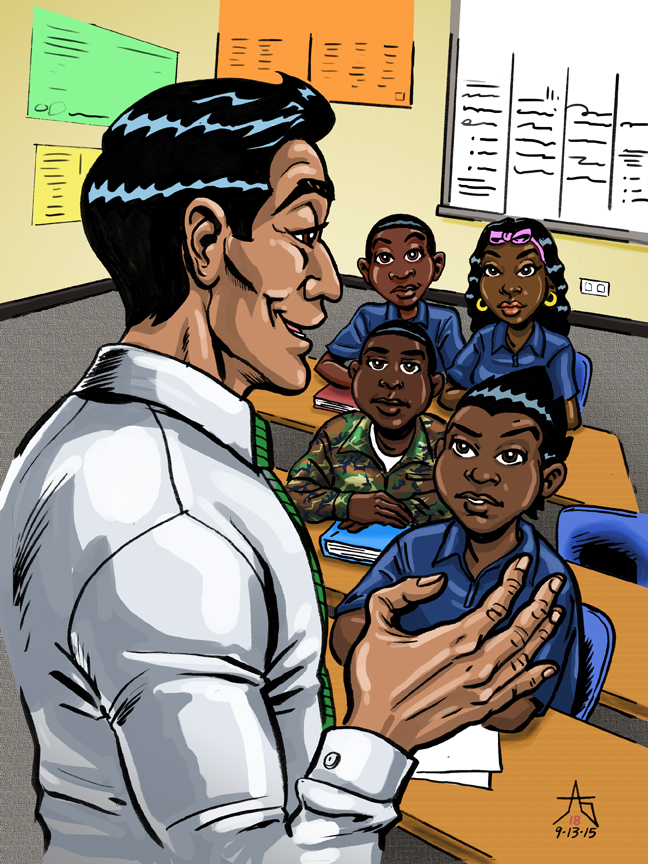
Silence.
I try to gauge the reaction.
Surely, they see right through me.
I mean, I’m no teacher. Hell, I’m barely a lawyer, apart from the degree I somehow fleeced from my law school. So what am I doing at this after-school program on the West Side of Chicago, working with these kids to develop comic stories based on their interests and ideas?
They have to know I have no idea what I’m doing.
It is then that one of the youth, a stout male named Nehemiah, finally raises his hand.
“So, like, these stories can be about anything we want them to be? I mean, can we just make stuff up or do they have to be true stories?”
“They can be about whatever you want—made up or based on real experiences. It’s entirely up to you.”
Another youth, a young African American female named Tamia, then raises her hand.
“Can they be about relationships?”
“Yep. Relationships. Friendships. School. Family. Or they can be completely made up and based on some sort of alternative reality.
Anything you want.”
I look around to see if the other youth seem engaged. I recall a conversation with one of the participating project artists, a former teacher, who had offered one simple piece of advice.
Fight silence. Even if you have to repeat yourself. Fight silence in the room. Any interaction is better than no interaction.
“So… like I said, anything you want. Anything.”
“The only limit is your imagination.”
Good God, I think to myself.
Did I just say that?
I promised myself I wasn’t going to say that. Such a lazy cliché.
These poor kids.
Yet somehow, despite my ineptitude, I notice one of the other students – a tall, angular kid named Russell sitting in the back of the room – looking as though he’s just on the verge of saying something.
And just as suddenly, another youth – an animated young man named Andre sitting in the front row – proclaims boldly,
“I’ve got an idea. I know what story I want to tell. And it’s going to be great!”
Holy s@#&, I think to myself.
Is that genuine interest I hear?
It can’t be.
The kid is setting me up.
Brace yourself…
Here it comes.
It is then that Nehemiah quickly responds,
“Damn, that was all sudden, man. So, what’s your idea? All passionate and stuff.”
Andre smiles.
“Well, that’s because it’s a great idea, if I do say so myself.”
He collects himself before continuing.
“Alright, so there’s a lot to it, but it all starts with me walking to a party that me and my friends heard about. You know, just a small house party a few blocks from my place. No big deal. And us being teens, we’re just thinking we’ll head down there, have a little fun, and hang out.”
I listen attentively as Andre’s hand gestures become more animated. Like me, Andre talks with his hands. I don’t know this kid from Adam, but I already like him.
“So, we get to this party, and it’s cool. Me and my boys arrive, and we see some people we know and some we don’t, but everyone’s hanging out and the vibe is cool.”
“And then, out of nowhere, we hear this commotion outside.”
“Commotion?” I ask. “What kind of commotion?”
Andre pauses for a moment.
“I don’t know… something like a ringing bell, maybe. But it’s different. It’s a sound that immediately draws me and two other guys outside into the alley where it’s coming from.”
To my surprise, I begin to picture the comic unfolding panel by panel in my mind.
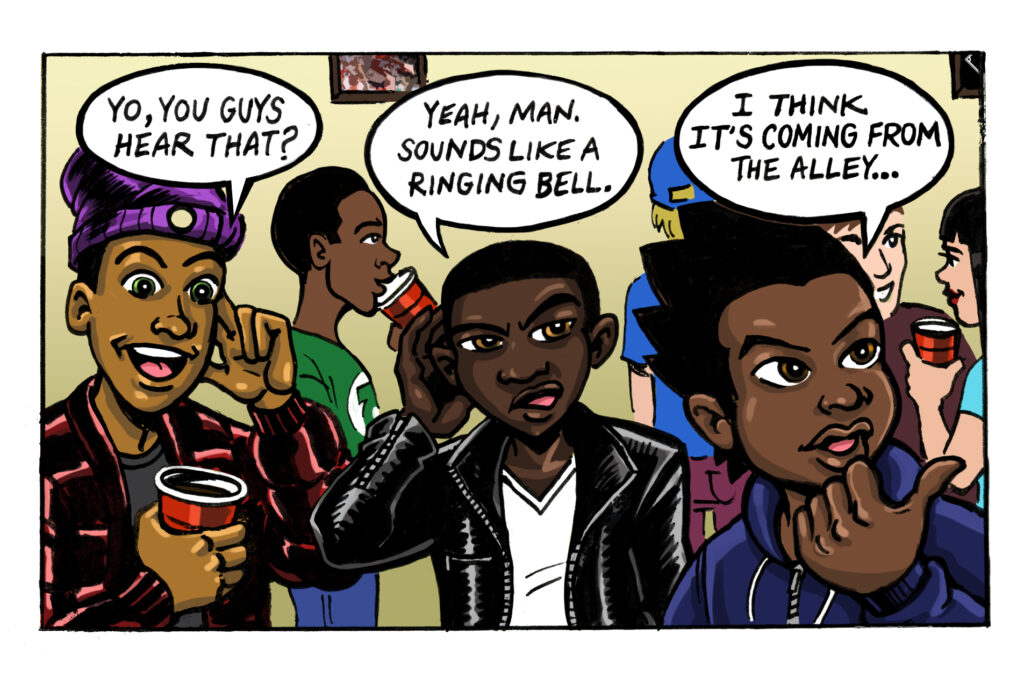
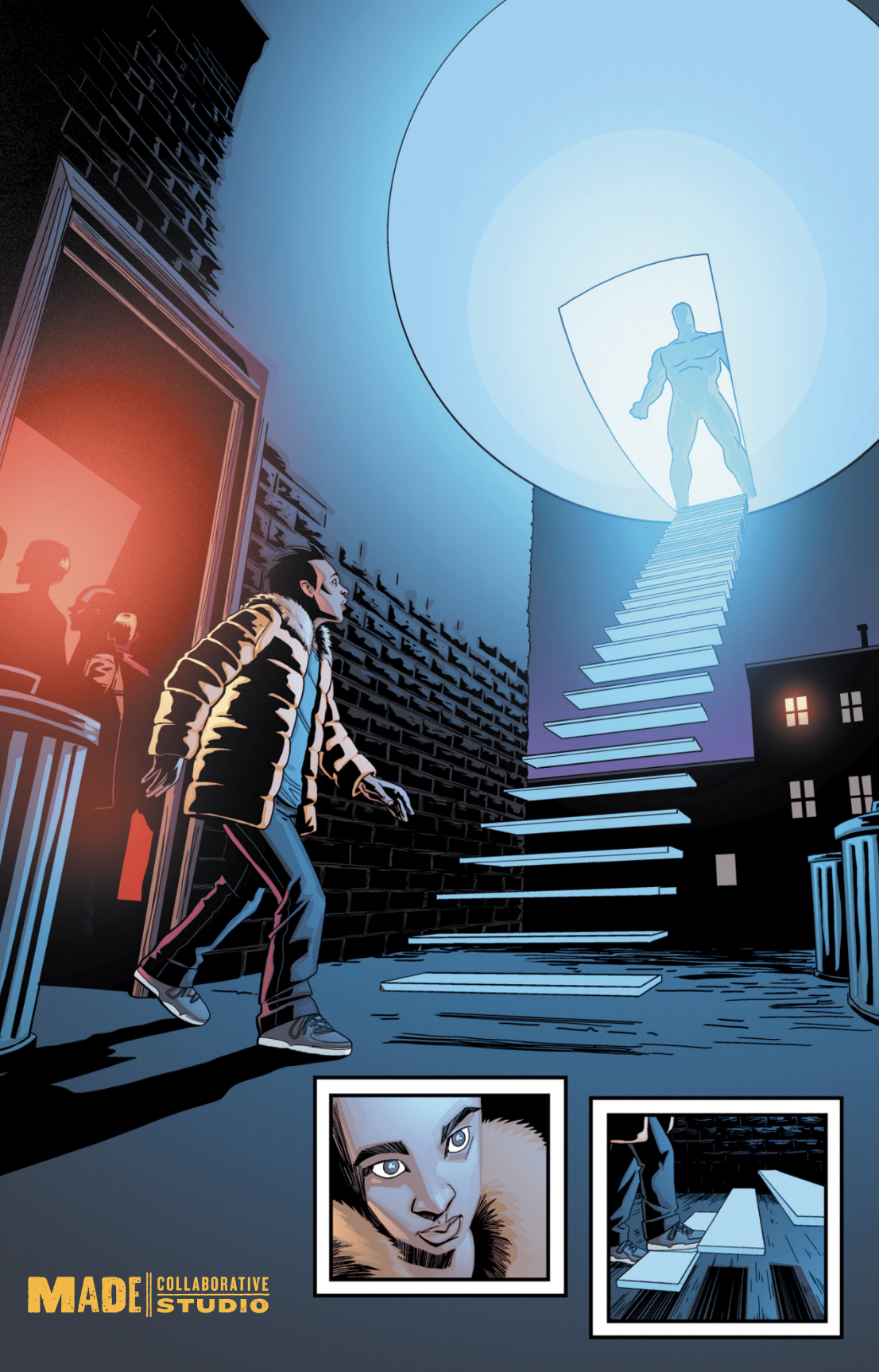
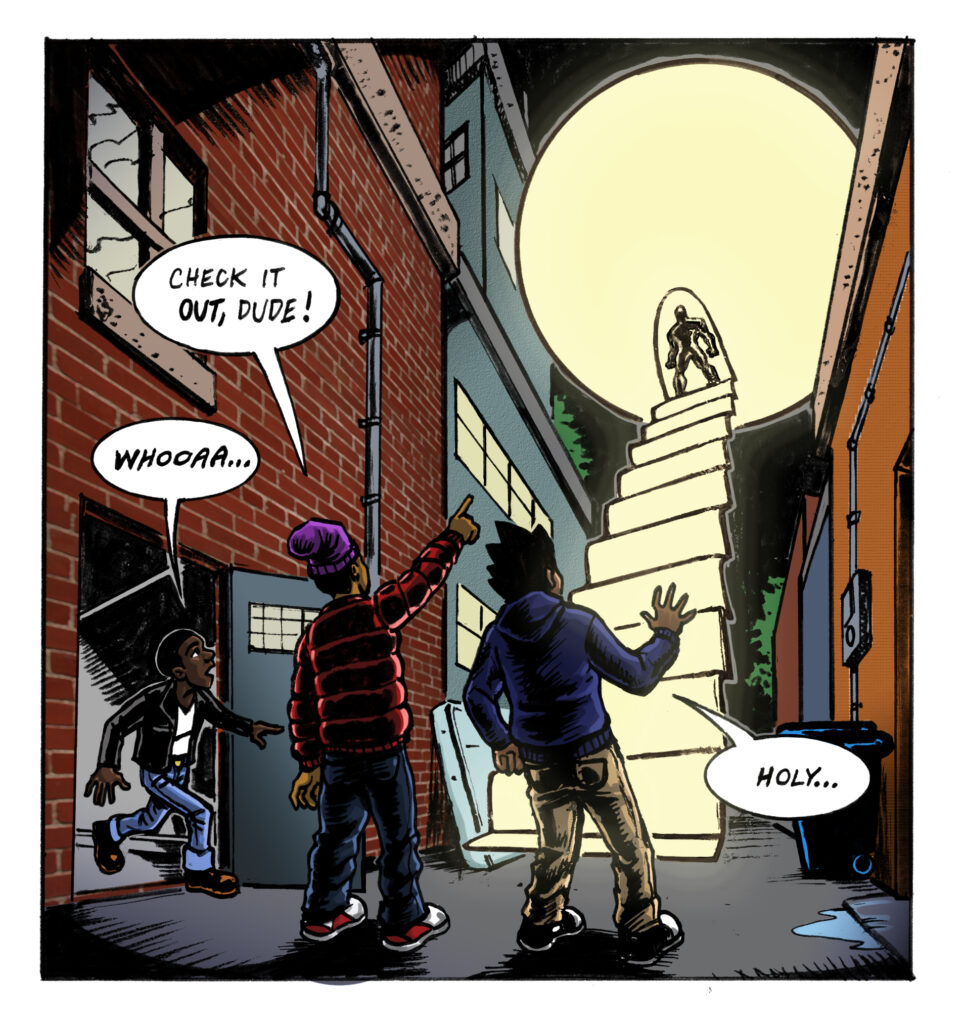
“So, we go out into the alley, and we see these stairs – like translucent, glowing stairs – rising out of nowhere and stretching up into the sky. Me and these two dudes, who I don’t really know but who were at the party, are just looking at each other like… holy #$^%!”
“And I’m kind of scared, but at the same time I see those two guys start walking up the stairs, and I immediately follow them. I’m thinking I’ve GOT to see what’s at the top!”
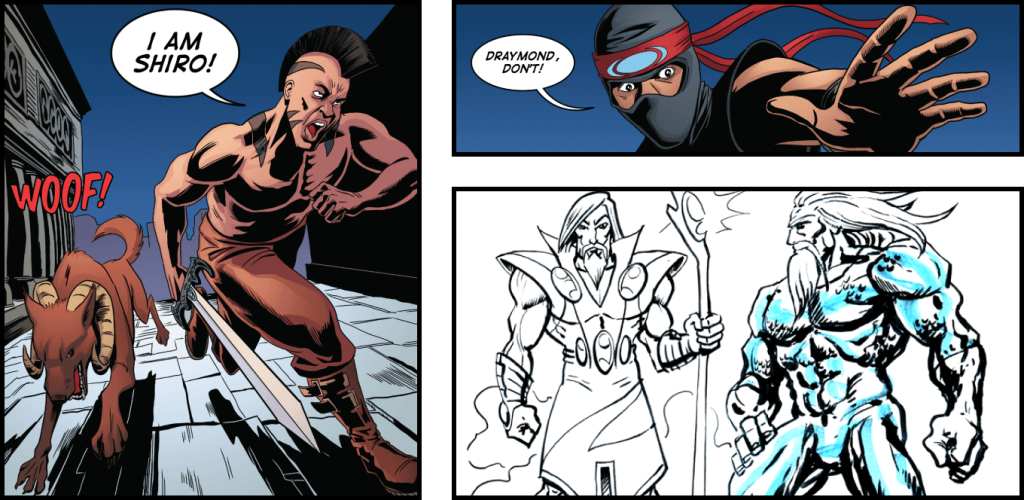
“So, we get to the top of the stairs, and that’s when we see this god-like figure. He kind of looks like Zeus, and he’s holding this long staff. We’re all looking at each other, not sure what’s happening, and I’m thinking to myself… is this a dream? But it feels so vivid and real that I’m just going out of my mind! And eventually I ask this Zeus-like dude to make me a God!”
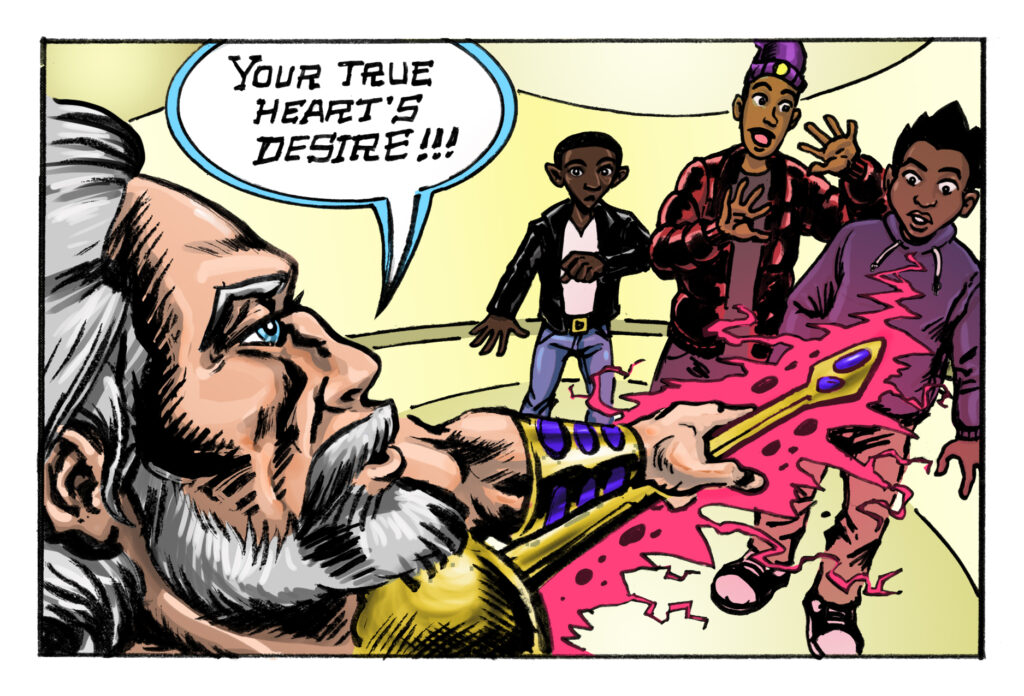
As Andre continues describing his story, I realize I’m no longer listening to a teenager simply describe a superhero comic. Beneath the action, he’s really talking about power, morality, and what it means to carry extraordinary responsibility while still trying to navigate an ordinary life on Chicago’s West Side.
“I mean, there’s a lot to it. There’d be a council of secret chiefs that would advise me as I develop my powers.”
“And I want death to be a central theme in my story. Actually, I want Death to be a character in my story that I’ll eventually have to confront.”
“I know that probably doesn’t make sense right now, but I can explain it more as we get into it.”
“The main thing is that this story will have a lot of different elements. It’s going to be deep. But I also want it to be fun. Kind of like me. I mean, I’d still be me, living in this neighborhood with the same family and friends.”
“So, there’s always going to be that normal stuff I’ve got to deal with as a kid around here.”
“I’d just be A GOD at the same time!“
Nehemiah is the first to respond.
“Yeah, that’s pretty good. I like that. You can do a lot with a story like that. Lots of action, too.”
Greg chimes in.
“Action and romance!”
“Romance? What, you in love with yourself? I didn’t hear any romance.”
Andre laughs.
“Yeah, I forgot to mention that one of the fellow gods I meet later is a young woman that I end up falling in love with.”
Nehemiah shakes his head. “Of course. And she probably looks like Beyoncé.”
Andre lights up.
“Now that’s not bad! Maybe I should introduce her at the beginning of my story!”
The boys laugh.
Eventually, we wrap things up for the day. The students gather their bags and begin the walk home through the neighborhood.
After they leave, I sit alone, going through my project notes.
And for perhaps the first time since starting this project, I think to myself:
Maybe… just maybe… we actually have something here.
Something that could genuinely bring value to both the participating youth and the artists who had volunteered their time.
But there was still one fundamental problem.
I had absolutely no idea how to transform these ideas into a complete comic story.
And on that score, I knew a great deal of work – and uncertainty – lay ahead.
As we prepare to launch our weekly virtual workshops, we thought it might be worth taking a little trip back to where this whole thing started.
Over the next few weeks, we’ll be revisiting some of the original blog entries from the early days of Made Collaborative — back when this was little more than an idea, a handful of participating artists, and a willingness to see what might happen if we brought some young people into the creative process.
A lot has changed since then. What began as a modest youth outreach initiative has gradually evolved into a collaborative comic book project, complete with its own fictional universe, an expanding cast of characters, and a growing collection of virtual tools designed to invite others into the creative process.
But the underlying idea remains much the same.
We hope these early reflections provide a little context for where we’ve been, what we’re building today, and why we’re still at it.
So, with that in mind, here’s our first entry.
An origin story, if you will …
Sparks From a Bus
By Jimmy Briseno
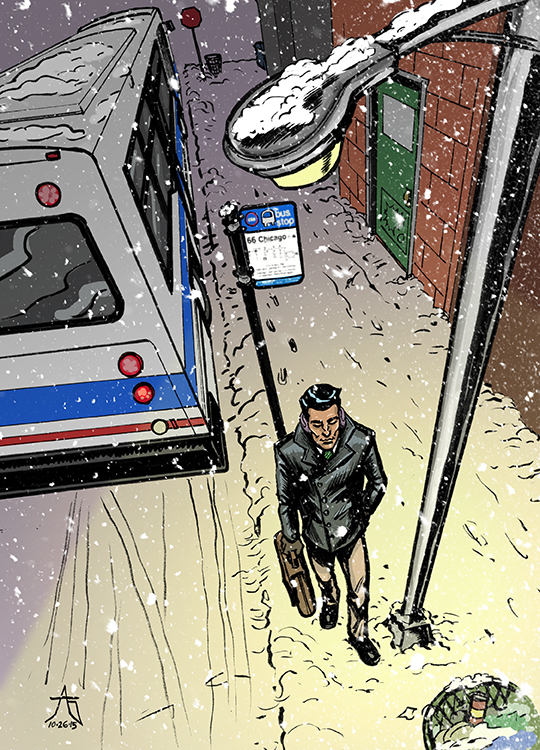
See that guy at the top of this blog entry? I guess that’s me, Jimmy Briseno, as depicted by participating artist John Golden sometime before this project began.
Looks like I’m deep in thought.
About what? Who the hell knows.
I could be contemplating just how incredible it is that all of us on this bus – with our own unique ancestral journeys through the ages – somehow find ourselves sharing this fleeting moment together, against all conceivable odds…
Or I could be wondering why my hometown Chicago Bulls don’t run more motion offense to create spacing for their perimeter shooters.
Both thoughts (and countless others) are equally likely to be occupying space in my mind at any given moment – sometimes seemingly at the same time.
And that’s me in a nutshell.
My mind is a complete mess. And unfortunately, I spend a lot of time there.
Back then, during those many bus rides home through Chicago, I was consumed by my job as a corporate attorney. Not because I loved it, but because my company had spent several years navigating corporate acquisitions and divestitures. More than anything, I think I was desperately searching for some semblance of work-life balance, which naturally resulted in even more daydreaming than usual.

At the same time, Chicago’s crime, corruption, and budget woes frequently dominated the headlines. There was plenty of negative energy to absorb, and that also inevitably occupied some space in my mind during those rides home.
Even then, however, I never viewed those problems as necessarily unique to Chicago. Many of our urban communities face similar challenges – problems that defy easy political soundbites or any single solution. And somewhere in the middle of those bus rides, I found myself wondering what someone like me – a guy with no particularly noteworthy skill whatsoever – could even do to help.
It was this line of introspection that often led me to think more about my rather ordinary life. Although I may not have been especially passionate about my work at the time, nor accomplished anything of particular note, I was nonetheless self-aware enough to know that I was lucky. Particularly whenever I looked back on my own childhood.
Purely as a statistic, my odds of achieving any measurable success out of the gate probably weren’t great. My dad was an absent and volatile figure who would ultimately lose his soul to drugs and mental illness. And as a kid, I grew up in a neighborhood not completely unlike many of those generating the headlines in Chicago.
But that’s where my journey along any statistical probability path abruptly ends.
The lucky part for me was that I had an extraordinary Mom who worked tirelessly to provide a comfortable life for the two of us, along with the love and support of my Grandparents and Godparents. Because of them, I found myself experiencing an entirely different set of life circumstances.
Even so, I still remembered what it felt like as a young kid to be shaped, in large part, by the external expectations of my neighborhood and early circumstances – particularly when those expectations were often negative.
And that’s when it hit me during one of those many bus rides home.
Why not develop some sort of youth outreach initiative that could help facilitate some little creative sparks, however modest?
I’d always believed creativity was undervalued. Even in the corporate world that I was immersed (trapped) in, the ability to think a little outside the box could lead to enormous dividends – in some cases, quite literally. And I was even more convinced that creativity was essential in fields like public service and science.
The irony, of course, is that programs promoting creativity within our urban communities always seem to be among the first sacrificed when budgets become tight. And the more I thought about it during those bus rides home, the more convinced I became that there had to be an opportunity to do something.
I myself experienced firsthand how being exposed to other people’s ideas could be incredibly empowering. Those little external sparks allow you to begin envisioning a world that transcends your own reality, whatever that reality may be. And that’s when new possibilities begin to emerge from within.
And perhaps more than anything, beyond youth empowerment, budget cuts, and Chicago’s headlines, I thought doing something that encouraged creativity could be fun. Maybe I could light a few much-needed creative sparks of my own. And as my mind wandered on those many bus rides home – whether contemplating the serendipity of life or the starting lineup for the Chicago Bulls – it became increasingly apparent that I simply needed a little more fun in my life.
Armed with that motivation during one of those many bus rides home during that Chicago winter many years ago, I finally decided to give it a go. I didn’t have a specific plan beyond recruiting a handful of local artists to collaborate with urban youth the following summer. I figured we’d simply see what emerged from that collaborative process and take it from there.
Little did I know, as I stepped off the bus that fateful winter evening with that very simple idea in mind, the origin story of this little comic-based collaborative project had just begun.