
0%

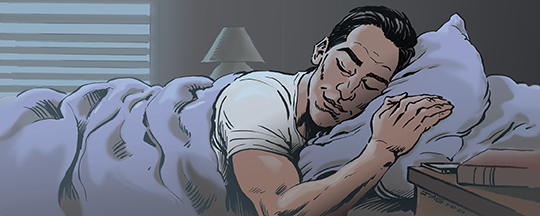
So, I had a dream.
And this is the honest-to-God truth.
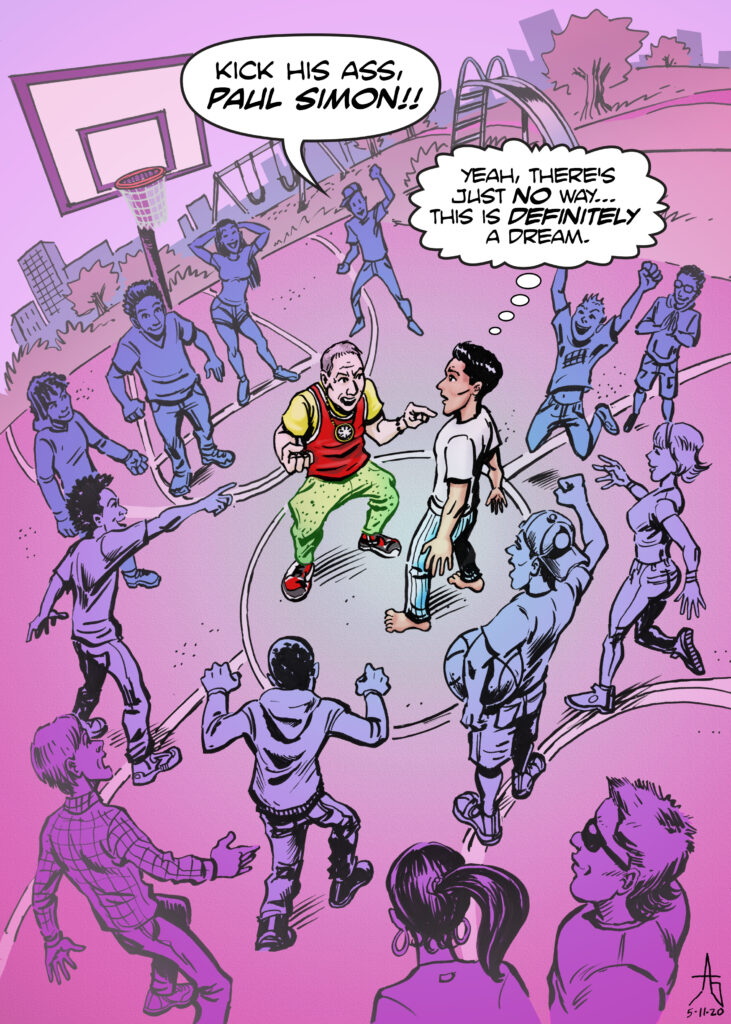
The other night, I dreamed that Paul Simon – you know, Paul Simon from Simon & Garfunkel? – was trying to fight me.
Paul who, some of you may ask?
Fair question.

Paul Simon is one of America’s most celebrated singer-songwriters. His career has spanned more than six decades and includes classics such as Bridge Over Troubled Water, Mrs. Robinson, Still Crazy After All These Years, and Fifty Ways to Leave Your Lover.
And not some young version of Paul Simon.
No.
The current nearly 80-year-old, 5’3″, 140-pound version of Paul Simon.
Yeah.
And I mean an actual fight.
There he was, taunting me as a crowd of onlookers gathered around us like some bizarre elementary school playground scene, all presumably waiting to watch Paul Simon kick my ass.
For what reason, only the dream gods know.
I remember waking up shortly after Paul Simon poked me in the chest and asked if I was “feeling froggy.”
I immediately nudged my then-fiancée – now wife – to tell her about the dream before I forgot it.
Just so damn random.
Thoroughly unimpressed, she rolled over, muttered something unintelligible (possibly in Polish), and went right back to sleep.
But I couldn’t shake it.
Paul Simon wanting to go fisticuffs?
What the hell was that about?
How do you even begin to psychoanalyze something like that?
Dreams…they’re funny things.
Of course, countless books and articles have been written about dreams. Some believe they’re windows into our subconscious – the fears, hopes, and unresolved conflicts that quietly shape us beneath the surface.
Others argue they’re simply our minds processing the events and problems of everyday life.
And still others insist they’re nothing more than random electrical impulses firing while our brains drift through REM sleep.
Who the hell really knows?
Perhaps it’s precisely because dreams remain such a mystery that they became such a recurring theme during our earliest collaborations with the participating youth.
Time and again, almost every young person we worked with referenced dreams as part of their stories or characters. No other theme appeared as often.
It was in that context that I began wondering whether dreams themselves could become the thread that connected these seemingly unrelated stories into one larger narrative. Maybe dreams could become the bridge.
Maybe they could become the doorway into a shared mythology that future youth could continue building upon. The idea intrigued me.
The execution…
That was another matter entirely.
By that point, I had conducted countless interviews with participating youth, worked alongside professional artists to produce concept sketches and illustrations, and even drafted early scripts. Yet something was still missing.
Creatively, I had hit a wall.
And as I thought about it more, perhaps that’s what Paul Simon represented in my dream.
Not Paul Simon, the musician. But Paul Simon, the creative giant. A towering artistic presence (figuratively speaking, of course) standing across from me, quietly exposing every insecurity I had about my own creative abilities.
And maybe the crowd surrounding us represented the participating youth whose ideas I was desperately trying to honor as I struggled to bring this project to life.
Or…
Maybe it really was nothing more than random brain impulses before a much-needed REM cycle. Either explanation seemed equally plausible. Regardless, one thing had become abundantly clear while I was dreaming about getting my ass kicked by Paul Simon.
I needed help.
Okay…
Let me be more specific.
I needed help with the project.
And on that score…
Enter Len Kody.
Some special pieces may be selected to appear in the Back of the Yards comic book. iPad/iPhone users, submit images from FILES (NOT from Photo Library).
Some special pieces may be selected to appear in the Back of the Yards comic book.
UPLOAD YOUR IMAGES BELOW
Some special pieces may be selected to appear in the Back of the Yards comic book.
UPLOAD YOUR IMAGES BELOW
Some special pieces may be selected to appear in the Back of the Yards comic book.
UPLOAD YOUR IMAGES BELOW
Some special pieces may be selected to appear in the Back of the Yards comic book.
UPLOAD YOUR IMAGES BELOW
Collaborate with professional artists by contributing some artwork of your own! Some special pieces may be selected to appear in the Back of the Yards comic book.
UPLOAD YOUR IMAGES BELOW